


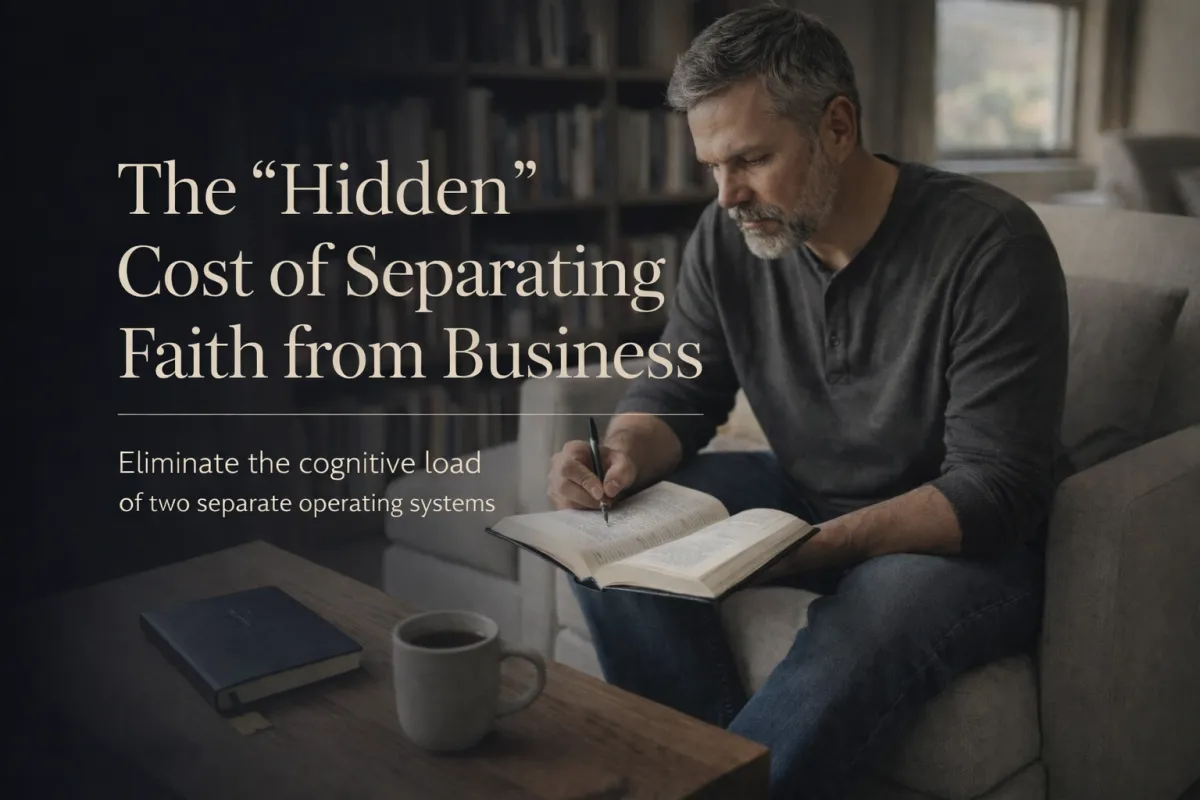
The "Hidden" Cost of Separating Faith from Business: Why Integration is the Key to CEO Clarity
You don't have a clarity problem. You have an integrity problem.
Not moral integrity, structural integrity. The kind that happens when you build two separate frameworks for making decisions and expect them both to hold weight.
Most Christian CEOs operate with one set of principles on Sunday and another set Monday through Friday. They pray for wisdom in the morning, then consult secular frameworks all day. They believe God cares about their business, but they make decisions as if He doesn't.
The cost isn't obvious at first. It's hidden in the exhaustion you feel after another quarter of solid numbers but zero peace. It shows up in the decision paralysis that hits when your board wants one thing and your conviction says another. It lives in the gap between who you are at church and who you become in the boardroom.
This isn't about being more religious at work. It's about eliminating the cognitive load that comes from maintaining two separate operating systems.

The Real Cost of Compartmentalization
When you separate faith from business, you don't just lose clarity. You lose credibility.
Your team feels it first. They watch you reference biblical principles in company meetings, then make decisions that contradict those same principles when the pressure is on. You don't even realize you're doing it. But embodied faith without operationalized faith reads as hypocrisy, not because you're a hypocrite, but because the integration never went deeper than surface level.
The internal cost is higher. Every decision becomes a negotiation between competing value systems. Should you lay off staff to hit margin targets, or hold the line on employment even if it costs you short-term growth? The secular framework says one thing. Your faith says another. So you split the difference and satisfy neither.
One CEO described it this way: He spent months trying to solve a competitive business challenge using "human wisdom", market analysis, consultant input, strategic pivots. Impasse after impasse. The moment he brought his faith-based values into the actual decision-making process, an elegant solution emerged that preserved both the business relationship and customer loyalty.
That's not mystical. That's what happens when you stop running two systems and start operating from one integrated framework.
What Integration Actually Looks Like
Integration isn't about praying before meetings or putting scripture on your website. It's about building decision-making structures that reflect what you actually believe.
Purpose alignment means your business goals and spiritual values occupy the same framework. You're not choosing between profit and ethics. You're not splitting the difference between growth and sustainability. You operate from a unified conviction about what success means: and that conviction guides every strategic choice without internal conflict.
This eliminates decision fatigue. When your values are clear and integrated, most decisions answer themselves. You don't second-guess. You don't wonder if you made the right call. You know what you're building and why it matters.
Decision-making confidence comes from having a constant moral compass. Leaders who separate faith from business often lack clear anchors during ethical dilemmas. They know what's legal. They know what's profitable. But they don't always know what's right: because "right" requires a framework that goes deeper than compliance or revenue.
Faith-integrated leadership provides that framework. Not as a spiritual add-on, but as the foundation. You make principled decisions faster because you're not calculating trade-offs between conflicting value systems. You're operating from conviction.

Team alignment and culture shift when integration is real. Employees can tell the difference between a company that markets faith and a company that operates from it. The first attracts people looking for a paycheck with better vibes. The second attracts people with shared conviction who want their work to matter beyond the bottom line.
That's not soft leadership. That's strategic advantage. Teams built on shared conviction outperform teams built on compensation alone: not because they're more spiritual, but because they're more aligned.
Why Most Leaders Get This Wrong
Most Christian business leaders treat faith integration like an add-on. They want to "bring faith into" their business, as if faith and business are two separate things that need to be blended.
That's the problem. Faith isn't something you bring into your work. It's the lens through which you see all of your work.
The add-on model produces three predictable failures:
Symbolic faith. You put a Bible verse on the wall or donate to charity, then make decisions exactly the way a secular CEO would. The integration is cosmetic, not operational. Your team sees it. Your clients feel it. And you wonder why it doesn't produce the clarity or culture you expected.
Compartmentalized faith. You keep faith in its lane: church, family, personal devotion: and keep business in its lane: strategy, operations, growth. The two never overlap. The result is internal tension that shows up as exhaustion, second-guessing, and a constant low-grade sense that something is off.
Performance faith. You use faith as a marketing angle or a differentiator, but it doesn't shape how you hire, fire, set strategy, or allocate capital. It becomes a brand position instead of an operational reality. And when the pressure is on, the brand position gets abandoned because it was never integrated into how you actually lead.
Real integration requires internalization. It's not technique. It's formation. Faith has to be operationalized through practices, embedded in decision-making structures, and embodied in how you show up: not just displayed in how you talk.
What Disciplined Leaders Do Differently
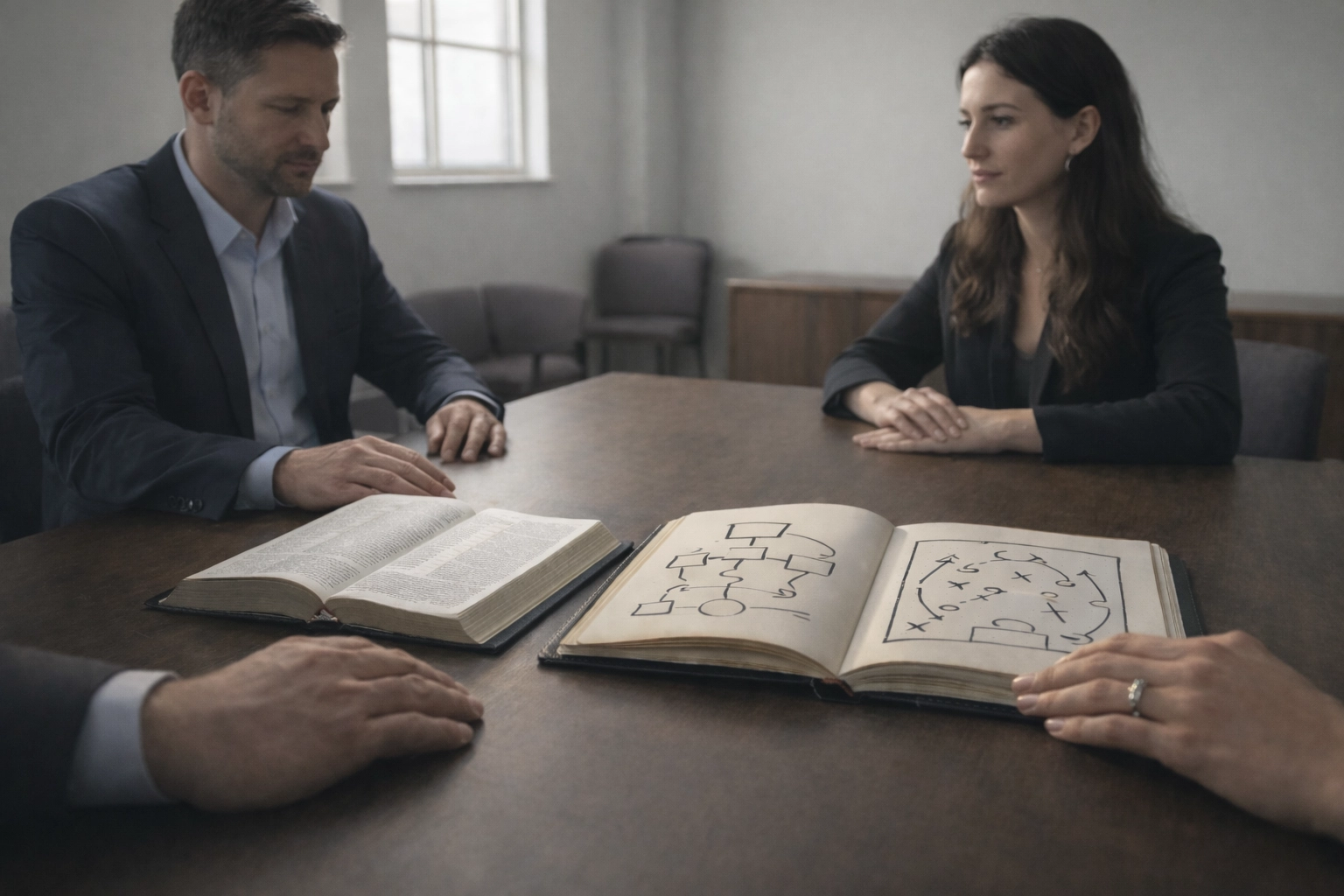
Leaders who integrate faith and business don't split their identity. They build one structure that holds both.
They start by defining their operating convictions. Not values statements for the website: actual principles that govern decisions when no one is watching. What does stewardship mean in your business? What does integrity require when it costs you margin? What does faithfulness look like when growth stalls?
Answer those questions with specificity, and most of your decision-making becomes clear.
They build rhythm around reflection. Integration doesn't happen once. It happens in the daily practice of bringing your faith convictions into real-time business challenges. That requires structure: time to think, space to pray, and people who can help you see when you're drifting back into compartmentalization.
Most CEOs don't lack faith. They lack the structure to keep faith integrated under pressure.
They surround themselves with peers who share the same framework. Secular peer groups won't challenge you to integrate faith and business: they'll challenge you to separate them. You need christian leadership development environments where integration is the norm, not the exception. Where other leaders are asking the same questions and holding each other accountable to the same standard.
That's why masterminds built for Christian CEOs work. Not because they're more spiritual, but because they eliminate the code-switching. You don't have to translate your convictions into secular language. You can lead from the whole of who you are.
The Framework: From Separation to Integration
If you want to move from compartmentalized leadership to integrated leadership, start with these three shifts:
Audit your decision-making. Look at your last five major decisions. Did your faith inform them, or did you consult secular frameworks and hope your faith would align later? If it's the latter, you're operating from separation.
Identify the tension points. Where do you feel the most internal conflict? Hiring decisions? Financial strategy? Competitive moves? Those tension points are where your faith and business frameworks are misaligned. Name them. Don't avoid them.
Rebuild from conviction. Take one area of your business and integrate it fully. Define what your faith convictions require in that area. Build structures that operationalize those convictions. Train your team to make decisions from that framework. Then expand to the next area.
Integration doesn't happen all at once. It happens one decision, one structure, one conviction at a time.

The Path Forward
You didn't separate faith and business on purpose. You did it because that's the default model. You watched other leaders do it. You absorbed the idea that business is pragmatic and faith is personal, and you built two systems without realizing the cost.
The cost is clarity. The cost is confidence. The cost is peace.
Faith based business coaching exists because most leaders can't make this shift alone. You need someone who can see where your frameworks diverge and help you rebuild them into one integrated structure. You need peers who are doing the same work and can challenge you when you drift back into compartmentalization.
The Focal Point Mastermind was built for this. It's not a Bible study for business leaders. It's a structured environment where Christian CEOs learn to lead from integrated conviction: where faith and strategy aren't two separate conversations, but one coherent framework.
If you're tired of maintaining two systems, it's time to build one that holds.
The clarity you're looking for isn't in another strategy. It's in the integrity of leading from one conviction instead of two.
Learn more about the Focal Point Mastermind and discover how faith-integrated leadership transforms decision-making, team alignment, and long-term clarity.